

Knitting Patterns for Cobweb and Fine Lace Yarns
Table of Contents
- Understanding the Difference Between Cobweb/Fine Lace and Lace Weight Yarn
- Best Needles for Cobweb Lace Projects
- Essential Lace Weight Knitting Techniques
- Pattern Construction and Stitch Fundamentals
- Blocking Delicate Lace Shawls
- Yarn Substitution for Cobweb Projects
- Care and Maintenance of Cobweb Garments
- Recommended Fine Lace and Cobweb Patterns to Start With
- Frequently Asked Questions
Last Updated: September 27, 2026
Understanding the Difference Between Cobweb/Fine Lace and Lace Weight Yarn
Cobweb is the finest weight in the lace yarn family, spun so delicately that a single 50-gram skein can hold 800 metres or more of fibre. At Watercolours and Lace, we offer patterns and kits that showcase its remarkable drape and finesse.
The difference between cobweb, fine lace and standard laceweight usually comes down to the number of strands of thread (ply) within the yarn and the effect this has on the length per 100g. Our traditional laceweights are usually 2-ply, giving 600-950m per 100g. We class Fine Lace yarns as having around 1,000-1,500m per 100g, and this usually consists of two finer threads plied together. Cobweb is normally between 1,500 and 2,400m per 100g, and often a single ply. There are, of course, some exceptions to this and there is some overlap, often depending on the fibre involved.
This distinction matters more than it sounds. Cobweb demands respect and is unforgiving of tension inconsistencies, yet rewarding when you get it right. The yarn creates an almost impossibly fine fabric with exceptional stitch definition, making it ideal for heirloom-quality shawls and delicate accessories that feel like a whisper against the skin.
The appeal is clear: cobweb produces garments with unmatched elegance. However, there is a learning curve to consider. Many knitters skip directly from standard yarns to cobweb, only to discover that techniques they've relied on for years behave differently at this weight. Pattern repeats that felt spacious in 4-ply suddenly feel cramped. Yarn overs create dramatic eyelets instead of subtle texture. Even blocking, the final magic that transforms lace, requires a gentler touch.
Best Needles for Cobweb Lace Projects
Choose needles between 2.75mm and 3.5mm for most cobweb lace patterns. The exact size depends on your pattern and personal tension, but this range works for the majority of, for example, traditional Shetland lace designs. Smaller needles (2.75mm-3.0mm) create tighter, more densely patterned fabric; larger needles (3.25mm-3.5mm) produce airier, more open stitch patterns.
Circular needles are often recommended for cobweb work, even when knitting flat. The weight of the yarn is so minimal that straight needles can become unwieldy, the needles themselves feeling heavy compared to the fibre you're working with. A 60cm or 80cm circular needle gives you enough length to distribute the stitches comfortably without bunching, and you can change up to a longer needle when necessary if increasing to a larger number of stitches.
What the needles are made from, as well as the fibre of the yarn, matters more than many knitters realise. Fine pointed metal needles are excellent for cobweb lace, as they make it easier to work single and multiple decreases, although some may find them more slippery than, say, wooden or bamboo needles. Fine wool yarns are often easier to knit with as they are a little more “sticky” and a dropped stitch won’t run quite so quickly as a silky yarn. Alpaca is more slippery than wool, but not as much as a pure silk, which is why we suggest those with less experience in knitting lace should practice with a yarn which is easier to handle.
The Yvaine Lace Stole, which was designed in Shetland cobweb weight, recommends 3.00mm circular needles, a size that balances the dramatic lace pattern with the delicate yarn. This recommendation reflects careful design, and starting with the needle size suggested in your pattern gives you the best foundation before experimenting with personal preference.

Yvaine Shetland Lace Stole, in Shetland Pure Wool Cobweb, 1 ply Lace
Essential Lace Weight Knitting Techniques
Working with cobweb light yarn requires precision in three core techniques: yarn overs, decreases, and tension management. Master these, and the rest becomes intuitive.
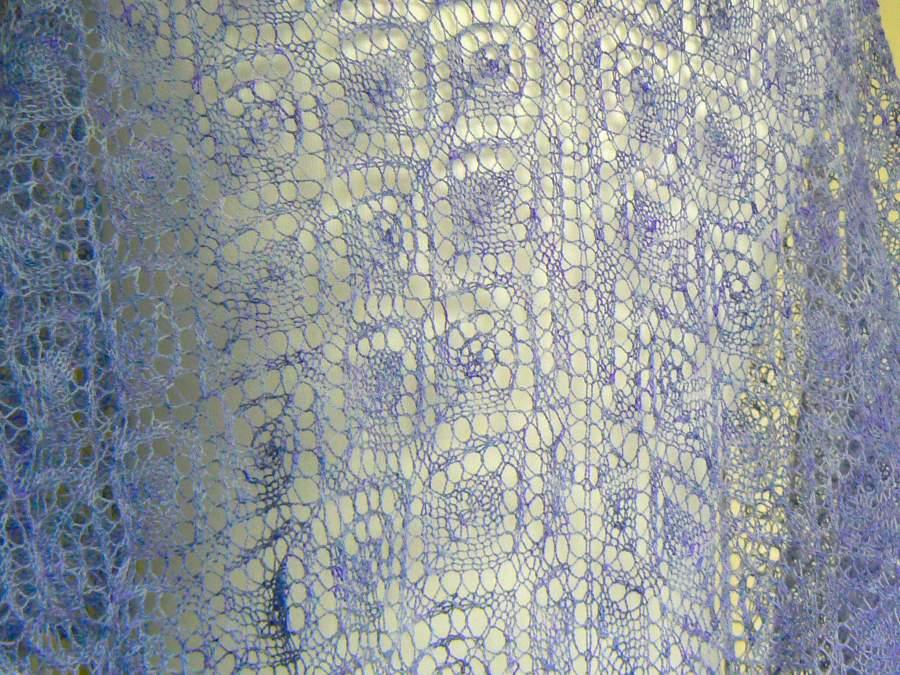
Abbey's Shawl, a triangle design, worked in Merino Fine Lace
Eyelet Lace and Yarn Overs
Yarn overs (yarn forward to many UK knitters) create the signature holes that define lace. In cobweb weight, even a single yarn over produces a dramatic eyelet. The motion is simple: bring your yarn to the front of the work, then knit the next stitch, which automatically wraps the yarn around the needle to create the hole.
The challenge lies in consistency. Each yarn over should create the same-sized eyelet across your entire pattern. Tension variation shows immediately. Too loose, and the hole becomes ragged; too tight, and the yarn overs bunch the surrounding stitches. The solution is repetition and awareness, knit your yarn overs with the same deliberate motion every time, treating them as a separate micro-skill within your overall knitting rhythm.
In pattern charts, yarn overs appear as small circles. They pair with decreases to maintain stitch count across rows. A yarn over followed by a k2tog (knit two together) creates a lace column; multiple yarn overs in sequence produce more dramatic eyelet patterns. The Eilidh Shawl uses this principle throughout its garter-stitch base, with yarn overs spaced strategically to create visual interest without overwhelming the delicate fibre.

Eilidh Shawl, in Shetland Cobweb Lace
Decreases and Stitch Count Management
Decreases pair with yarn overs to balance the stitch count. Without decreases, yarn overs would expand your knitting into an unwieldy mess. The most common decreases in lace are k2tog (knit two together) and s1k1psso (slip 1, knit 1, pass slipped stitch over) or ssk (slip, slip, knit), each creating a subtle slant in the fabric.
K2tog slants right; s1k1psso or ssk slants left. Experienced lace knitters use this directional quality intentionally, placing decreases to echo the pattern's visual flow. In cobweb weight, the slant becomes pronounced, you'll see the direction of every decrease reflected in the final blocked fabric.
Counting stitches matters obsessively in lace. A single missed yarn over or decrease throws off your stitch count for the entire remaining project. Many knitters find it easier to mark each pattern repeat with a stitch marker - you can then see quite quickly if you’ve missed or added a stitch, without having to check the whole row.
Eilidh Shawl Kit in Shetland Cobweb Lace →
Pattern Construction and Stitch Fundamentals
Lace shawl patterns fall into two broad categories: all-over lace, which covers the entire fabric with pattern, and border lace, which uses patterning only at the edges. Fine yarns excels at both, though each demands different planning.
All-over lace patterns can use either a garter-stitch (wrong side knit) or stocking stitch (wrong side purl) base. Simpler designs include alternate plain knit or purl rows that provide visual rest between patterned rows - often referred to as Lace Knitting. This structure keeps the knitting manageable - our Abbey’s Shawl design follows this format and makes the design suitable for intermediate knitters. More complex designs, including many Shetland lace stitches, include pattern on both right and wrong side rows - this is often called Knitted Lace, to distinguish it from Lace Knitting. Without rest rows, more concentration is required and such designs are more suited to advanced and expert knitters. The Yvaine Stole uses this approach, with very few unpatterned rows within the design.
Border lace constructs a central panel in stockinette or garter stitch, then adds patterned edgings at the sides and/or top and bottom. This approach works beautifully for shawls and stoles, where the pattern frames the finished piece.
Tension or gauge, the number of stitches and rows per centimetre, is critical but often misleading with cobweb and fine lace weight. Fine yarn can stretch significantly when blocked, so your pre-blocking tension differs from your finished gauge. Many patterns account for this by suggesting a looser gauge than you'd expect, then relying on blocking to tighten the fabric into its final form. It is essential to follow the pattern instructions when working a tension swatch, to check whether the designer used blocked or unblocked measurements, as these are likely to make a considerable difference to the finished piece.
Blocking Delicate Lace Shawls
Blocking transforms cobweb and fine lace from a crumpled mass of yarn into an elegant, geometric fabric. The delicate fibre requires a gentler approach than standard laceweight, but the principles remain the same: wet the finished piece, stretch it into shape, and allow it to dry completely. This can take 24-48 hours depending on humidity and air circulation. Patience here is non-negotiable.
Once fully dry, remove the pins carefully and admire the transformation.
Yarn Substitution for Cobweb Projects
Substituting yarn for a cobweb light pattern requires understanding the relationship between weight, yardage, and finished dimensions. You cannot simply swap a 2-ply laceweight for 1-ply cobweb without adjusting the pattern, as the fabric may be too dense. If you are changing the yarn weight, you are likely to need to change needle size too, so a tension swatch is even more important to check the fabric behaves as you want and expect it to.
Care and Maintenance of Cobweb Garments
Cobweb lace garments can be heirloom pieces, so treat them accordingly. Hand-wash in cool water, never machine-wash and definitely don’t put anywhere near a tumble drier!! The delicate 1-ply fibre cannot withstand agitation, even on a gentle cycle.
Recommended Fine Lace and Cobweb Patterns to Start With
Pattern Name |
Skill Level |
Finished Size |
Needle Size |
Best For |
|---|---|---|---|---|
Intermediate |
140cm x 68cm (small size) |
3.00mm circular |
First fine lace project |
|
Intermediate to Advanced |
210cm × 50cm |
3.00mm circular |
First cobweb project |
|
Yvaine (2-ply) |
Expert |
66cm × 188cm |
3.50mm circular |
Transition from laceweight to cobweb |
Yvaine (Cobweb) |
Expert |
80cm × 202cm |
3.00mm circular |
Experienced lace knitters |
Abbey’s Shawl offers the gentlest entry into fine lace/cobweb knitting. Its stocking stitch base provides straightforward purl rows between patterned rows, making it more forgiving than designs with pattern on every row. The crescent shape is also psychologically easier, as you're not committing to a massive rectangular stole for your first cobweb project. At just 50g of yarn, it's achievable in a few weeks of consistent knitting.
Frequently Asked Questions
What is the difference between cobweb yarn and standard lace weight?
Cobweb light yarn is typically 1-ply, significantly finer than standard 2-ply lace weight. A single skein of cobweb can yield 800m or more from just 50g, compared to 400–500m for standard laceweight at the same weight. This extreme fineness creates more delicate, translucent fabric with greater drape, making it ideal for heirloom-quality shawls and stoles. Cobweb weight requires smaller needles (usually 2.5–3.5mm) and demands more attention to tension and stitch count management.
What needle size should I use for cobweb lace knitting?
Most cobweb lace patterns call for needles between 2.75mm and 3.5mm, depending on the desired gauge and fabric density. Finer needles (2.75–3.0mm) create tighter, more defined lace patterns with crisp eyelet definition. Slightly larger needles (3.25–3.5mm) produce a more open, drapey fabric. Circular needles are essential for larger projects like shawls and stoles, as they distribute weight evenly and reduce hand fatigue. Always swatch with your chosen needles to verify gauge before committing to a full project.
How do I block delicate cobweb lace to enhance the pattern?
Blocking is essential for cobweb lace to reveal the full beauty of stitch patterns and achieve even drape. Wet-block by soaking the finished piece in cool water for 15–20 minutes, then gently squeeze out excess water without wringing. Pin the damp piece to blocking dimensions, stretching gently to open up eyelets and pattern repeats. Allow 24–48 hours to dry completely. For stoles and shawls, pin along the edges and any pronounced points to maintain the intended shape and ensure even tension across the cobweb fabric.
Can I substitute a different yarn for a cobweb lace pattern?
Yes, but substitution requires careful consideration of weight, yardage, and fibre content. A 2-ply standard laceweight can replace cobweb if you adjust needle size upward by 0.5–1.0mm and recalculate gauge. Always knit a swatch with the substitute yarn using your intended needle size to confirm stitch count and finished dimensions. Hand-dyed, 100% natural-fibre yarns like Shetland wool offer the translucency and drape that enhance lace patterns.
What projects work best for cobweb light yarn?
Cobweb yarn excels in projects where delicate texture and light weight matter: rectangular stoles, triangular shawls, lace-edged garments and fine wraps. Shetland lace stoles, crescent shawls, and centre-out designs are traditional choices that showcase cobweb's translucency and drape. Avoid dense, heavily textured patterns or garments requiring substantial yarn weight. Shawls and stoles require 800–1600m of cobweb, making them ideal one or two-skein projects. The heirloom quality of cobweb makes it perfect for special-occasion pieces rather than everyday wear.