
How to Read Yarn Weight Charts: A 2026 Guide
Table of Contents
- The Standard Yarn Weight System Explained
- How to Read a Yarn Label and Ball Band
- Using the Wraps Per Inch (WPI) Method
- How to Check Yarn Gauge Before You Start
- Knitting Yarn Weight Conversion Chart for International Yarns
- Yarn Substitution Maths: Swapping Weights Without Ruining Your Project
- Fibre Content vs. Weight: Why Two Yarns of the Same Weight Behave Differently
- Frequently Asked Questions
Last Updated: September 22, 2026
The Standard Yarn Weight System Explained
Learning how to read yarn weight charts starts with one fact most crafters discover too late: the numbers on a yarn label are a category, not a measurement. The Standard Yarn Weight System, developed by the Craft Yarn Council, sorts yarn into numbered categories from 0 to 7 based on strand thickness. At Watercolours and Lace, we work almost entirely in the fine end of that scale, so we see first hand how much confusion the numbering causes.
The 0-7 Categories and What They Mean
The eight categories run from 0 (lace) to 7 (jumbo), each carrying a recommended gauge range rather than a fixed thickness:
Category |
Name |
Typical Gauge (st st, 10cm) |
Common Uses |
|---|---|---|---|
0 |
Lace |
33-40+ sts |
Shawls, cobweb garments |
1 |
4-ply / Super Fine / Fingering |
27-32 sts |
Socks, fine shawls |
2 |
Fine / Sport |
23-26 sts |
Light garments, baby wear |
3 |
Light / DK |
21-24 sts |
Sweaters, accessories |
4 |
Medium / Worsted |
16-20 sts |
Everyday garments, blankets |
5 |
Bulky / Chunky |
12-15 sts |
Quick hats, thick sweaters |
6 |
Super Bulky |
7-11 sts |
Rugs, oversized accessories |
7 |
Jumbo |
6 sts or fewer |
Arm knitting, extreme texture |
How to Read a Yarn Label and Ball Band
A ball band answers four questions at a glance: what the yarn is made of, how much you have, what category it falls into, and what gauge the manufacturer achieved on a specific needle. Read the fibre content first, since it tells you how the yarn will drape and block, then find the recommended needle or hook size and gauge swatch information.
Three things on the band deserve a second look:
- Yardage or metreage per skein, which determines how many balls you need, not the weight in grams
- Dye lot number, critical for hand-dyed yarns where colour can shift between batches
- Suggested gauge, always stated with the needle size used to achieve it
Yarn Weight Symbols and Icons
Most modern labels replace or supplement the number with a small pictogram: a skein icon crossed with a needle, sometimes paired with the category number. If a band shows a symbol rather than a number, treat the symbol as the category and confirm the gauge range against the chart above. When a label shows no symbol at all, as hand-dyed skeins often won't, fall back on wraps per inch or a gauge swatch.
Using the Wraps Per Inch (WPI) Method
The wraps per inch (WPI) method is the most reliable way to identify an unlabelled or ambiguous yarn: wrap the strand around a ruler, count how many wraps fit in one inch, and match that number to a category. It takes two minutes and needs no special tools.
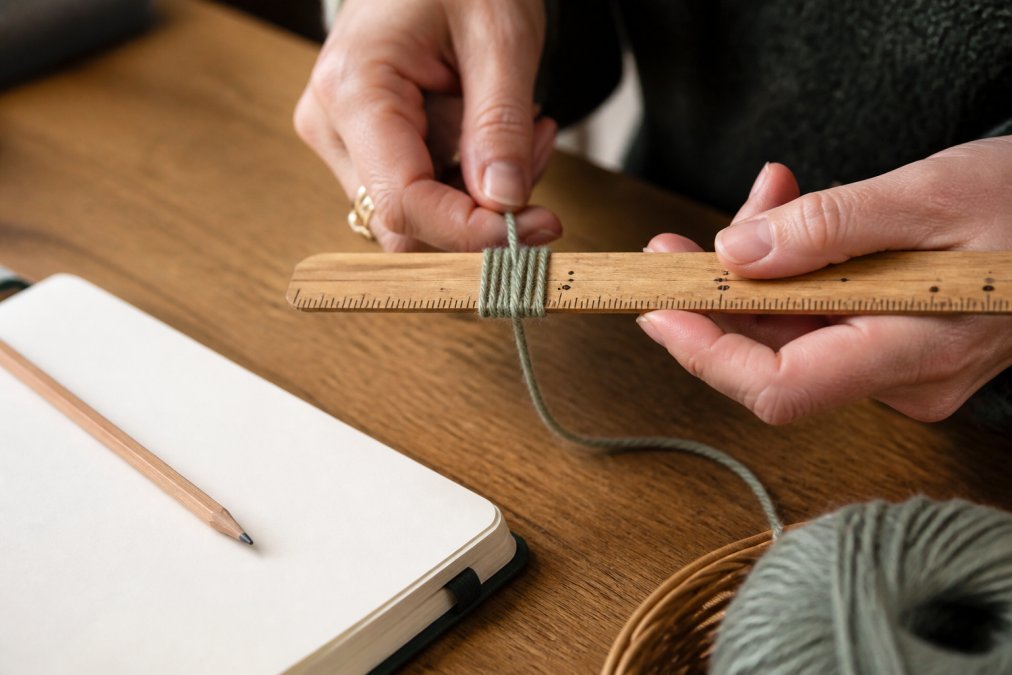
Here is the process:
- Lay a ruler on a flat surface and hold the yarn end steady at the zero mark
- Wrap the yarn around the ruler, snug against the previous wrap, without stretching it
- Stop when you reach the one-inch mark and count the wraps
- Wrap a second time and average the two counts for accuracy
The Finger Test: Identifying Yarn Weight by Touch
When you don't have a ruler handy, or you're sorting unlabelled skeins, your fingers can give you a fast read on weight category. This tactile method isn't precise enough for substitution math, but it's a reliable first pass.
- Lace (0): Thinner than sewing thread; almost invisible when held at arm's length. You can barely feel it between your fingers.
- 4-ply/Fingering (1): Comparable to embroidery floss or a fine crochet cotton. You can feel the individual strand clearly but it's still delicate.
- Sport (2): Slightly thicker than fingering, roughly the diameter of a standard paper clip.
- DK (3): About the thickness of a wooden matchstick or a standard chopstick.
- Worsted (4): Comparable to a pencil lead or a standard drinking straw.
- Bulky (5): About the thickness of a marker pen or a AA battery.
- Super Bulky (6): Thicker than your thumb; you can't easily wrap it around a finger.
- Jumbo (7): Rope-like; often requires both hands to manage a single strand.
WPI Calculator: From Wraps to Category
WPI Range |
Category |
Common Name |
|---|---|---|
30+ |
0 |
Lace |
14-18 |
1 |
4-ply / Super Fine / Fingering |
12-13 |
2 |
Fine / Sport |
11-13 |
3 |
Light / DK |
8-10 |
4 |
Medium / Worsted |
6-7 |
5 |
Bulky / Chunky |
4-5 |
6 |
Super Bulky |
0-3 |
7 |
Jumbo |
For a quick sanity check, wrap the yarn around a pencil and count how many wraps fit in one inch. Twelve suggests DK or light worsted, 8 suggests worsted, and 20 suggests fingering or sport. Less precise than a ruler, but a good field technique when sorting a stash.
How to Check Yarn Gauge Before You Start
Checking gauge means knitting or crocheting a swatch, washing it, and measuring your stitch count against the pattern's requirement. This is the step everyone skips and everyone regrets. A difference of two stitches per 10cm across a sweater body can shift the finished size by several centimetres.
- Bind off loosely and block the swatch the way you will block the finished piece
- Lay it flat, place a ruler across the centre, and count stitches over 10cm
- Count rows over 10cm as well, since row gauge affects length
- Compare both numbers to the pattern; if you are off, change needle size and swatch again
Knitting Yarn Weight Conversion Chart for International Yarns
Region |
Common Term |
Rough US Category Equivalent |
Notes |
|---|---|---|---|
US |
Fingering |
1 (Super Fine) |
Also called sock yarn |
UK |
4-ply |
1-2 (Super Fine to Fine) |
Thinner than US sport |
UK |
DK |
3 (Light) |
Double knitting; similar to US light worsted |
UK |
Aran |
4 (Medium) |
Slightly heavier than US worsted |
Australia |
8-ply |
3 (Light / DK) |
Often sold as "8-ply" in Australian patterns |
Australia |
12-ply |
4 (Medium) |
Comparable to US worsted |
Europe |
"Fine" / "Sport" |
2 (Fine) |
Terms vary by country |
Europe |
"Medium" |
4 (Medium) |
Often used for worsted-weight yarns |
Another trap is the word "worsted." In the US, it's both a weight category (4) and a spinning method (worsted-spun, smooth and dense). In the UK, "worsted" is rarely a weight term; you'll see "Aran" or "DK" instead. If a British pattern calls for "worsted weight," it usually means a medium-weight yarn, but always check the gauge.
Yarn Substitution Maths: Swapping Weights Without Ruining Your Project
For fine-weight projects, curated kits can remove some of the guesswork.
Fibre Content vs. Weight: Why Two Yarns of the Same Weight Behave Differently
When you buy hand-dyed luxury natural fibres, ask about the base as well as the weight. The Textile Institute's resources on fibre properties explains how spinning and fibre choice affect finished fabric, which is worth understanding before you commit an expensive skein to a project.
Frequently Asked Questions
How can I tell what weight yarn I have if the label is missing?
Use the wraps per inch (WPI) method. Wrap yarn around a ruler without gaps or overlaps, count how many strands fit in one inch, then match that number to a standard chart. Lace weight is around 30-40 WPI, fingering 14-30, DK 11-14, worsted 9-11, and bulky 5-7. You can also compare thickness against a known yarn or check the recommended needle size from a similar project.
What is the difference between sport, DK, and worsted weight yarn?
Sport weight sits between fingering and DK, usually knitting at 23-26 stitches per 4 inches on 3.25-3.75mm needles. DK weight works at 21-24 stitches on 3.75-4.5mm needles. Worsted weight is thicker at 16-20 stitches on 4.5-5.5mm needles. Each step up adds thickness and reduces stitch count, so a pattern written for worsted will produce a denser fabric if you substitute sport weight without adjusting.
How do I match my yarn weight to the correct needle or hook size?
Start with the recommended needle or hook size printed on the yarn label or the pattern. Knit or crochet a swatch at least 10cm square, then measure your stitch count. If you have more stitches than the pattern states, go up a needle size; if fewer, go down. The right size is the one that gives you the pattern's gauge, not the one printed on the ball band.
Why does gauge matter when reading a yarn weight chart?
Gauge tells you how many stitches and rows fit into a set measurement, usually 10cm. Two yarns can share the same weight category but knit at different gauges because of fiber content, twist, or ply. If your gauge is off, garments come out the wrong size, and lace patterns lose their intended openness. Always swatch and block before starting a project.
Is yarn weight 4 the same as DK?
No. In the standard yarn weight system, number 4 is worsted weight, not DK. DK is category 3 (light). Worsted knits at roughly 16-20 stitches per 4 inches, while DK knits at 21-24 stitches. If a pattern calls for DK and you use worsted, the finished fabric will be thicker and larger unless you adjust your needle size and stitch count.
How do I use a knitting yarn weight conversion chart for international patterns?
International patterns often use different names. UK and Australian patterns may call worsted 'aran' or '10-ply', and what Americans call DK, UK knitters may call '8-ply'. A conversion chart maps these names to the 0-7 numbering system and to WPI ranges. Always check the gauge stated in the pattern, since that is the most reliable cross-reference regardless of what the yarn is called.